High-volume EMS agencies know that documentation can make or break workflow efficiency. For JFK EMS, which serves a 600-square-mile region with more than 135,000 annual dispatch calls, paper-based charting became a major operational obstacle.
Clinicians often relied on handwritten notes or personal devices, which meant important details were captured hastily, inconsistently, or insecurely. These methods not only slowed chart completion but also introduced opportunities for data omissions and errors. As a result, QA/QI reviewers worked from fragmented documentation, adding time and complexity to an already demanding process.
A Better Way To Chart
As a data-driven organization, JFK EMS knew its documentation process wasn’t sustainable. Charts were frequently incomplete; clinicians had to complete large portions off-shift, and reviewing cases for improvement was increasingly difficult due to inconsistencies or delays. The agency needed a mobile, secure, and intuitive solution that reduced the friction that caused gaps in chart quality.
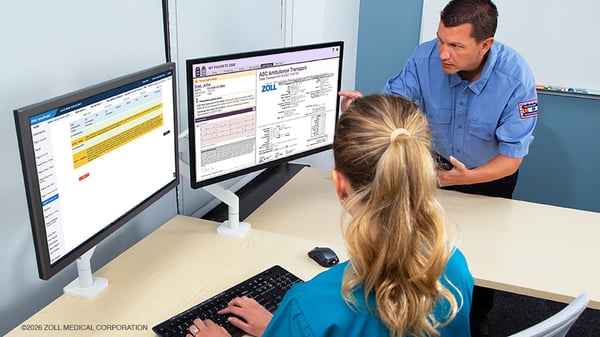
Adopting ZOLL emsCharts® NOW gave clinicians the ability to document patient encounters on scene in real time, eliminating reliance on paper and personal devices. Features like streamlined demographic, signature, and medical history capture, along with integrated waveforms and ECGs, effectively addressed the pain points that slowed charting and complicated QA/QI efforts. The app quickly became a go-to tool, not only because it was easier to use, but because it aligned naturally with how clinicians already worked in the field.
See How They Did It
While many clinicians embraced the app immediately, others took longer to adapt, and responding to variation became an important part of the JFK EMS story. Through a combination of peer influence, hands-on training, and successful use cases within the agency, adoption steadily grew.
JFK EMS didn’t just implement a new tool: they collectively reimagined their documentation process and achieved measurable results.
Download the case study to learn how JFK EMS improved efficiency and performance, strengthened QA/QI processes, and increased clinician satisfaction.


 Jul 22, 2026
 1 min read